Stop-Motion Is Real
LIMNMEDIA
Open-source and open-hardware systems
for the camera side of stop-motion.
Calibration. Accuracy. Alignment.
One frame at a time.
Publications
Pan Bearing Stack Assembly for the Stop-Motion Camera Head
By Christopher
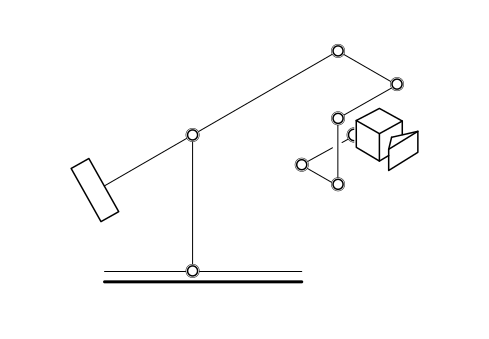
This set of images shows the pan bearing stack being assembled into the LIMNMOCO stop-motion crane camera head using a shoulder bolt, shaft collar, bearings, and the current prototype pan drive arrang
Pan Axis Fitment & Camera Head Direction
By Christopher
This set of images shows the fitting of the pan axis in the LIMNMOCO stop-motion crane camera head.
Tilt Drive Fitment & Off-the-Shelf Constraints
By Christopher
This set of images shows the fitting and layout work for the tilt drive components on the LIMNMOCO stop-motion crane.
What Is Stop-Motion?
Stop-motion is a form of animation where real-world objects are moved by hand — one frame at a time — to create motion on screen.
Long before pixels and pipelines, stop-motion was the trick that brought cinema to life. Frame by frame, real objects were moved and captured — creating illusions that felt magical and alive.
It shared a path with cinema for over a century: from Méliès and Harryhausen to modern studios like Will Vinton, Skellington, and Aardman. Every frame was made by hand.
Then came the computer. CG and cinema evolved together. Stop-motion kept going — but its tools stayed behind.
Stop-Motion was left behind.
While live-action and CG adopted digital pipelines, real-time cameras, and on-set compositing — stop-motion didn’t get the update.
Its rigs were handmade. Its camera stayed fixed. Its systems were passed down like shop secrets — not shared infrastructure.
That’s not romantic. That’s a bottleneck.
Apparatus Cinema
Stop-motion evolved around a fixed camera. The illusion of movement was built — not tracked. This became its visual grammar.
The Fork in the Road
The industry split. CG and live-action gained pipelines, APIs, virtual tools. Stop-motion stayed physical, isolated, and under-supported.
Indexical Virtualism
LIMNMEDIA’s approach isn’t to fake stop-motion with CG — It’s to build digital tools that respect real cameras, physical space, and analog methods.